
Protein Molecular Weight Markers

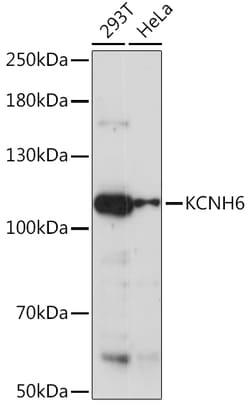
ABclonal Technology KCNH6 Rabbit pAb

Voltage-gated potassium (Kv) channels represent the most complex class of voltage-gated ion channels from both functional and structural standpoints. Their diverse functions include regulating neurotransmitter release, heart rate, insulin secretion, neuronal excitability, epithelial electrolyte transport, smooth muscle contraction, and cell volume. This gene encodes a member of the potassium channel, voltage-gated, subfamily H. This member is a pore-forming (alpha) subunit. Alternative splicing results in multiple transcript variants that encode different isoforms.

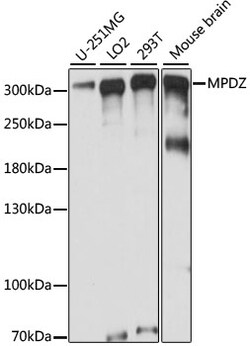
ABclonal Technology MPDZ Rabbit pAb
The protein encoded by this gene has multiple PDZ domains, which are hallmarks of protein-protein interactions. The encoded protein is known to interact with the HTR2C receptor and may cause it to clump at the cell surface. Multiple transcript variants encoding different isoforms have been found for this gene.
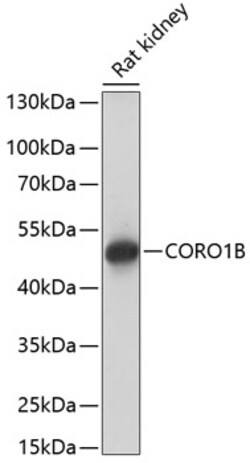
ABclonal Technology CORO1B Rabbit pAb
Members of the coronin family, such as CORO1B, are WD repeat-containing actin-binding proteins that regulate cell motility (Cai et al., 2005 [PubMed 16027158]).
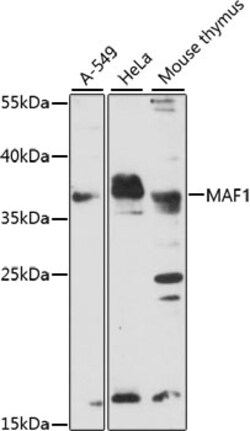
ABclonal Technology MAF1 Rabbit pAb
This gene encodes a protein that is similar to Maf1, a Saccharomyces cerevisiae protein highly conserved in eukaryotic cells. Yeast Maf1 is a negative effector of RNA polymerase III (Pol III). It responds to changes in the cellular environment and represses pol III transcription. Biochemical studies identified the initiation factor TFIIIB as a target for Maf1-dependent repression.
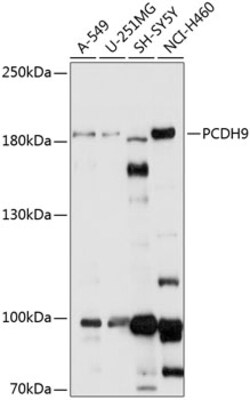
ABclonal Technology PCDH9 Rabbit pAb
This gene encodes a member of the protocadherin family, and cadherin superfamily, of transmembrane proteins containing cadherin domains. These proteins mediate cell adhesion in neural tissues in the presence of calcium. The encoded protein may be involved in signaling at neuronal synaptic junctions. Sharing a characteristic with other protocadherin genes, this gene has a notably large exon that encodes multiple cadherin domains and a transmembrane region. Alternatively spliced transcript variants encoding distinct isoforms have been found for this gene.
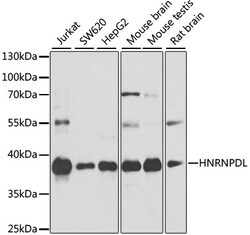
ABclonal Technology HNRNPDL Rabbit pAb
This gene belongs to the subfamily of ubiquitously expressed heterogeneous nuclear ribonucleoproteins (hnRNPs). The hnRNPs are RNA binding proteins and they complex with heterogeneous nuclear RNA (hnRNA). These proteins are associated with pre-mRNAs in the nucleus and appear to influence pre-mRNA processing and other aspects of mRNA metabolism and transport. While all of the hnRNPs are present in the nucleus, some seem to shuttle between the nucleus and the cytoplasm. The hnRNP proteins have distinct nucleic acid binding properties. The protein encoded by this gene has two RRM domains that bind to RNAs. Three alternatively spliced transcript variants have been described for this gene. One of the variants is probably not translated because the transcript is a candidate for nonsense-mediated mRNA decay. The protein isoforms encoded by this gene are similar to its family member HNRPD.
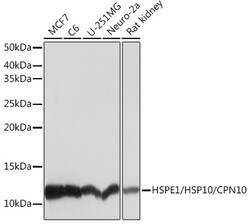
ABclonal Technology HSPE1/HSP10/CPN10 Rabbit mAb
This gene encodes a major heat shock protein which functions as a chaperonin. Its structure consists of a heptameric ring which binds to another heat shock protein in order to form a symmetric, functional heterodimer which enhances protein folding in an ATP-dependent manner. This gene and its co-chaperonin, HSPD1, are arranged in a head-to-head orientation on chromosome 2. Naturally occurring read-through transcription occurs between this locus and the neighboring locus MOBKL3.
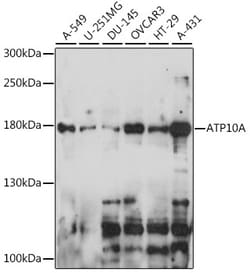
ABclonal Technology ATP10A Rabbit pAb
The protein encoded by this gene belongs to the family of P-type cation transport ATPases, and to the subfamily of aminophospholipid-transporting ATPases. The aminophospholipid translocases transport phosphatidylserine and phosphatidylethanolamine from one side of a bilayer to another. This gene is maternally expressed. It maps within the most common interval of deletion responsible for Angelman syndrome, also known as happy puppet syndrome.
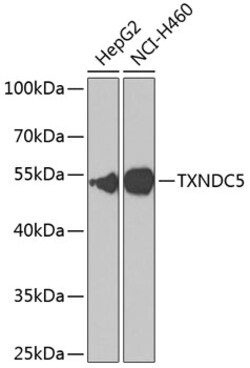
ABclonal Technology TXNDC5 Rabbit pAb
This gene encodes a member of the disulfide isomerase (PDI) family of endoplasmic reticulum (ER) proteins that catalyze protein folding and thiol-disulfide interchange reactions. The encoded protein has an N-terminal endoplasmic reticulum (ER)-signal sequence, three catalytically active thioredoxin domains and a C-terminal ER-retention sequence. Its expression is induced by hypoxia and its role may be to protect hypoxic cells from apoptosis. Alternative splicing results in multiple transcript variants. Read-through transcription also exists between this gene and the neighboring upstream BLOC1S5 gene.
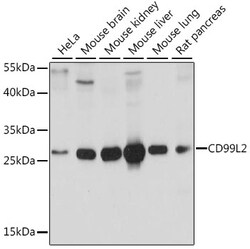
ABclonal Technology CD99L2 Rabbit pAb
This gene encodes a cell-surface protein that is similar to CD99. A similar protein in mouse functions as an adhesion molecule during leukocyte extravasation. Alternate splicing results in multiple transcript variants.
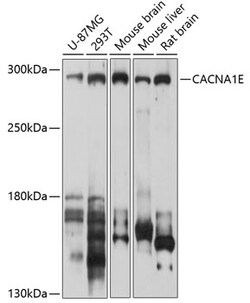
ABclonal Technology CACNA1E Rabbit pAb
Voltage-dependent calcium channels are multisubunit complexes consisting of alpha-1, alpha-2, beta, and delta subunits in a 1111 ratio. These channels mediate the entry of calcium ions into excitable cells, and are also involved in a variety of calcium-dependent processes, including muscle contraction, hormone or neurotransmitter release, gene expression, cell motility, cell division and cell death. This gene encodes the alpha-1E subunit of the R-type calcium channels, which belong to the high-voltage activated group that maybe involved in the modulation of firing patterns of neurons important for information processing. Alternatively spliced transcript variants encoding different isoforms have been described for this gene.
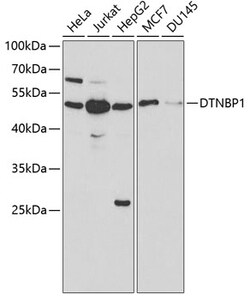
ABclonal Technology DTNBP1 Rabbit pAb
This gene encodes a protein that may play a role in organelle biogenesis associated with melanosomes, platelet dense granules, and lysosomes. A similar protein in mouse is a component of a protein complex termed biogenesis of lysosome-related organelles complex 1 (BLOC-1), and binds to alpha- and beta-dystrobrevins, which are components of the dystrophin-associated protein complex (DPC). Mutations in this gene are associated with Hermansky-Pudlak syndrome type 7. This gene may also be associated with schizophrenia. Multiple transcript variants encoding distinct isoforms have been identified for this gene.
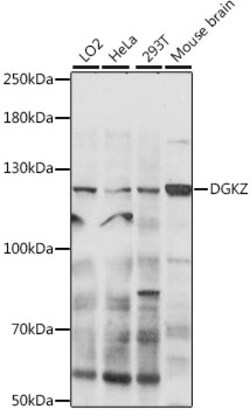
ABclonal Technology DGKZ Rabbit pAb
The protein encoded by this gene belongs to the eukaryotic diacylglycerol kinase family. It may attenuate protein kinase C activity by regulating diacylglycerol levels in intracellular signaling cascade and signal transduction. Alternative splicing occurs at this locus and multiple transcript variants encoding distinct isoforms have been identified.
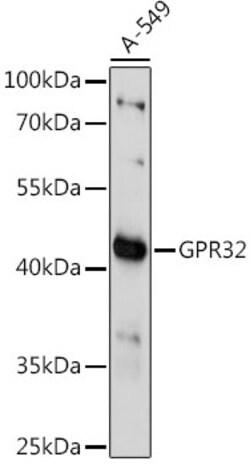
ABclonal Technology GPR32 Rabbit pAb
This gene is intronless and encodes a member of the G-protein coupled receptor 1 family. The encoded protein binds to resolvin D1 and lipoxin A4 and has been linked to pulmonary inflammation. A related pseudogene has been identified on chromosome 19.
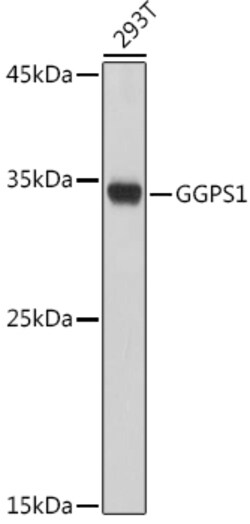
ABclonal Technology GGPS1 Rabbit pAb
This gene is a member of the prenyltransferase family and encodes a protein with geranylgeranyl diphosphate (GGPP) synthase activity. The enzyme catalyzes the synthesis of GGPP from farnesyl diphosphate and isopentenyl diphosphate. GGPP is an important molecule responsible for the C20-prenylation of proteins and for the regulation of a nuclear hormone receptor. Alternate transcriptional splice variants, both protein-coding and non-protein-coding, have been found for this gene.